Imaging and color measurement · Reports
CAM16 background coupling and Hellwig–Fairchild fit tradeoffs
Coupled terms change the interpretation
Color appearance models connect colorimetry with perceptual attributes under specified viewing conditions. Because their equations are coupled, changing one term can have a consequence that is obscured when the term is quoted by itself. The source paper likewise warns that a local change can affect other parts of a color appearance model. The practical question is how the isolated term behaves when the surrounding terms are restored.
What the source paper argues
Hellwig and Fairchild revisit how CIECAM02 and CAM16 relate brightness to lightness, and trace the nonlinearity between them to a transcription rather than to a measurement in the development from the Hunt model to CIECAM97s.
They state the consequence as a thought experiment. Asked to pick the gray card halfway between black and white by lightness, and then again by brightness, an observer picks the same card. CAM16 instead predicts different cards, with its middle-lightness card lighter than its middle-brightness card.
Replacing that nonlinearity forces a reevaluation of the chroma, colorfulness,
and saturation equations, which is where the background-dependence question
below comes from. The paper also identifies a limit case in the current
formulation: below a background luminance factor of 20, chroma rises for every
color and tends toward infinity as Y_B approaches zero. It attributes that
behavior to the N_cb term.
This report reproduces selected consequences of those equations, uses the corrected colorfulness coefficient, and compares the paper’s reported fits for brightness, chroma, and colorfulness.
Normalized brightness
Within one fixed viewing-condition contract, normalized CAM16 brightness is:
Q / Q_white = sqrt(J / 100)
The proposed relation is linear:
Q / Q_white = J / 100
Both map J = 0 to black and J = 100 to white. Inside that interval they
differ: at J = 25, CAM16 gives 0.5 while the linear relation gives 0.25;
at J = 50, they give approximately 0.707 and 0.5. The calculation shows
the consequence of the two definitions.
Isolated and coupled background behavior
Holding every other term fixed, the N_cb^0.9 contribution relative to
Y_background = 20 reduces to:
isolated factor = (20 / Y_background)^0.18
| Relative background | Isolated factor |
|---|---|
| 20 | 1.000 |
| 5 | 1.283 |
| 1 | 1.715 |
| 0.1 | 2.595 |
That is only one factor inside CAM16 chroma. Restoring the other background-dependent terms gives:
C(Y_background) / C(20) =
    (n_ref / n)^0.18
  × [(1.64 - 0.29^n) / (1.64 - 0.29^n_ref)]^0.73
  × (J_ref / 100)^[(z(n) - z(n_ref)) / (2 z(n_ref))]

n = Y_background / 100
z(n) = 1.48 + sqrt(n)
The implementation holds the adapted responses fixed and sweeps reference
lightness from J = 10 through 90.
| Relative background | Isolated factor | Coupled-expression range |
|---|---|---|
| 5 | 1.283 | 1.112–1.263 |
| 1 | 1.715 | 1.416–1.725 |
| 0.1 | 2.595 | 2.120–2.687 |
At Y_background = 5, the coupled result stays below the isolated factor. At
1 and 0.1, it crosses that factor as lightness changes. The direction and
size of the difference therefore depend on both background and reference
lightness; the isolated 2.595× value does not describe the coupled response.
Corrected coefficient and mixed fit results
Equation 23 was corrected on 22 April 2022, after first online publication.
The authors’ downloadable early copy still shows 47, while the corrected
article and the Colour implementation use 43. This implementation uses the
corrected form:
M = 43 N_c e_t sqrt(a² + b²)
For N_c = e_t = 1 and a 3-4-5 opponent vector, direct substitution gives
43 × 5 = 215, providing a compact numerical check of the corrected form.
The paper reports the following coefficients of determination:
| Dataset / correlate | CAM16 | Proposed relation | Reported in |
|---|---|---|---|
| LUTCHI brightness | 0.86 | 0.95 | Figure 2 |
| Munsell chroma | 0.87 | 0.96 | Figure 6 |
| LUTCHI colorfulness | 0.81 | 0.71 | Figure 7 |
The proposal’s reported coefficients are higher for brightness and chroma but lower for colorfulness on the listed datasets. The authors argue that the colorfulness tradeoff preserves proportionality with brightness as scene luminance changes, so saturation remains invariant to luminance level. They also leave the relation between colorfulness and adapting luminance open for further study.
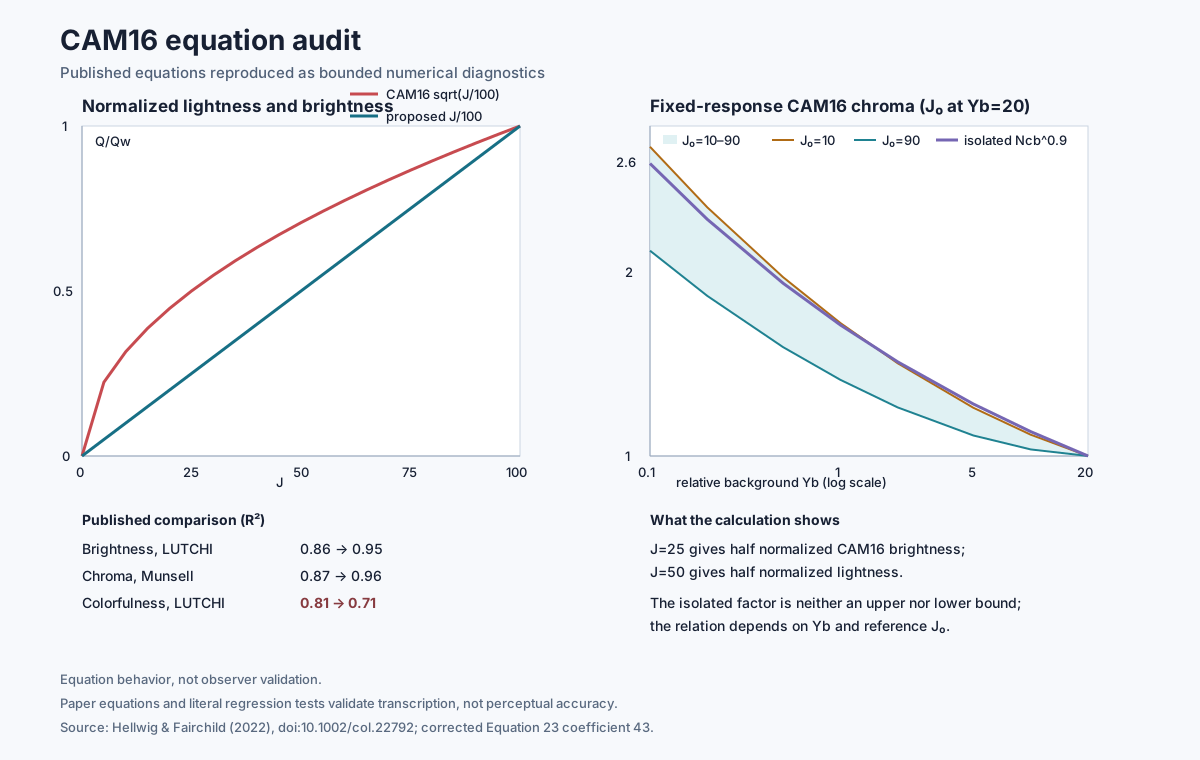
The straight brightness line is the proposed relation; the curved line is CAM16. The center panel compares the isolated term with the coupled range. The right panel shows all three fit statistics reported in the paper.
Scope of the result
This calculation includes no observer data. Determining which formulation better predicts appearance requires measurements designed for that question.
Neither this audit nor the standalone comparator maps results into CAM16-UCS. That follows the paper’s own limit on how far its proposal has been carried: CAM16-UCS was outside its scope and would need to be revised and fitted again before these changes could be used there.
Source
Luke Hellwig and Mark D. Fairchild, “Brightness, Lightness, Colorfulness, and Chroma in CIECAM02 and CAM16,” Color Research & Application 47 (2022), 1083–1095, doi:10.1002/col.22792.
Equation 23 carries a correction added 22 April 2022, after first online publication. The corrected form is the one implemented here.
Source file: reports/cam16-equation-audit.md