Imaging and color measurement · Studies
How do you know a color matrix is not just fitted to its own data?
A camera’s RAW RGB values are not colorimetry. Two cameras photographing the same chart under the same light record different numbers, and neither set is CIE XYZ, because each sensor’s spectral sensitivities differ from the human observer’s. The usual bridge is a color-correction matrix: a linear 3×3 fit from one camera’s RGB into XYZ for a declared capture condition.
The difficulty is that such a matrix is easy to make look good. Fit it on 140 patches, report the error on those same 140 patches, and you have measured how well the fit reproduces its own training data — which is not the question anyone is asking.
This study fits the matrix and then reports error on patches the fit never saw.
Held-out error came to 4.134 mean CIEDE2000 against 4.099 on the training patches — a gap of 0.035, so these five patch partitions show little overfitting. The more useful result is what the design caught: restricting the fit to lighter patches produced a headline that looked 22% better while all-patch error stayed at 4.126 and the excluded dark patches remained poorly predicted at 7.952.
What was done
Each of 140 chart patches is sampled from the RAW frame after black subtraction and demosaic, corrected by a measured flat field, and white balanced. The reference side comes from the chart’s spectral reflectances rendered under a measured illuminant, giving the XYZ each patch should produce.
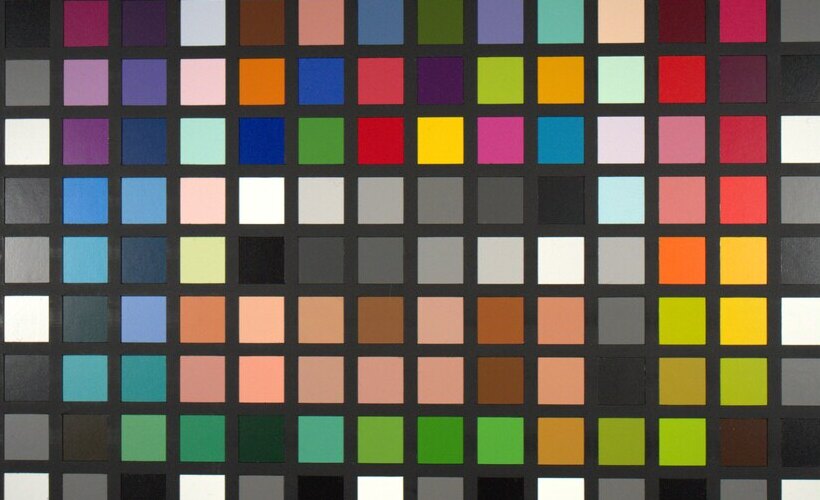
A reduced crop of the captured chart, showing the patch grid the 140 samples are drawn from. Illustration only — the crop omits the full target and is not a calibration reference or an analysis input.
The fit is repeated over five deterministic partitions of the patch set. Each time, four fifths of the patches train the matrix and the remaining fifth is evaluated. Every patch is held out exactly once, and the reported error comes only from patches the matrix had not seen.
Error is reported as CIEDE2000, a perceptual color-difference measure where lower is closer.
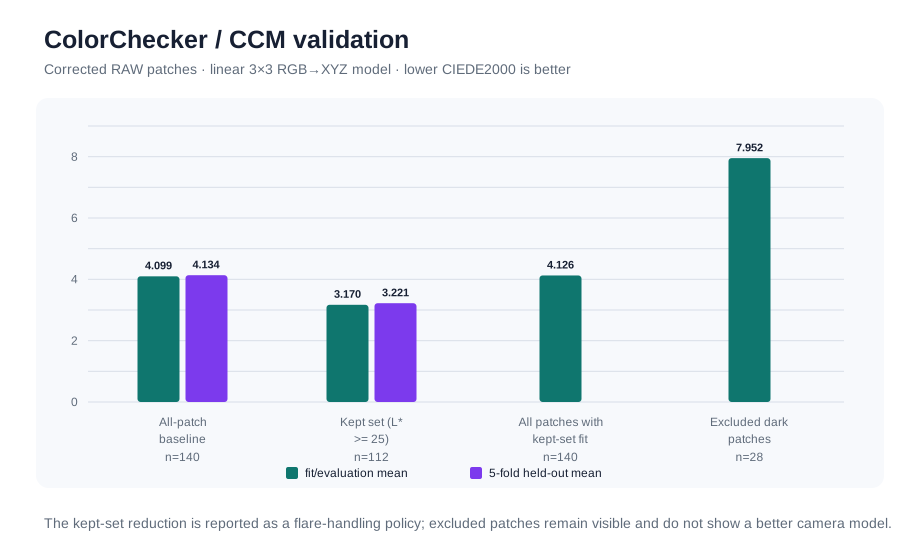
Lower is better. The first two groups compare training error with five-fold
held-out error, for all 140 patches and for the 112-patch L* ≥ 25 kept set.
The last two bars evaluate the kept-set fit on all 140 patches and on the 28
excluded dark patches.
The result
| Evaluation | Patches | Training | Held out |
|---|---|---|---|
| All-patch baseline | 140 | 4.099 | 4.134 |
Kept set, L* ≥ 25 |
112 | 3.170 | 3.221 |
| All patches, under the kept-set fit | 140 | 4.126 | — |
| Excluded dark patches | 28 | 7.952 | — |
Held-out error exceeded training error by 0.035. That small gap is the answer to the opening question: across these deterministic patch partitions, the training score is representative of the patches withheld from each fit. It argues against patch-fold overfit within this calculation. It does not show that the matrix will transfer to another chart, illuminant, or capture session.
The reported 4.134 is the residual for this complete camera–capture–reference–model path. No observer experiment or declared viewing condition was part of the archive, so the value is not converted into a count of just-noticeable differences. It also cannot be assigned to the camera alone: model limitation, capture flare, and reference mismatch remain coupled.
The result the design was built to catch
Restricting the fit to patches above L* = 25 dropped held-out error from
4.134 to 3.221 — a 22% improvement, and a much better-looking headline.
It is not an all-patch improvement. Under that same restricted fit:
- all 140 patches changed only from 4.134 to 4.126;
- the 28 excluded dark patches measured 7.952.
The lower kept-set score did not transfer to the complete chart. It came from removing the hardest subset from that average while the subset remained poorly predicted. The 4.134 figure is therefore the result this study quotes.
Plausible contributors include flare in the bright-surround capture and mismatch between the compatible reference and the photographed chart unit. These data cannot establish their relative contributions or exclude other capture-path effects.
Reference implementation
The relevant calculation from the public C++ implementation.
CcmFit fit_matrix_only(const std::vector<CameraRgbPatch>& camera_rgb,
                       const std::vector<Xyz>& target_xyz) {
  std::array<std::array<double, 3>, 3> normal{};
  std::array<std::array<double, 3>, 3> rhs{};
  for (std::size_t i = 0; i < camera_rgb.size(); ++i) {
    const auto rgb = rgb_array(camera_rgb[i]);
    const std::array<double, 3> xyz = {
        target_xyz[i].x, target_xyz[i].y, target_xyz[i].z};
    for (std::size_t row = 0; row < 3; ++row) {
      for (std::size_t col = 0; col < 3; ++col) {
        normal[row][col] += rgb[row] * rgb[col];
      }
      for (std::size_t channel = 0; channel < 3; ++channel) {
        rhs[channel][row] += xyz[channel] * rgb[row];
      }
    }
  }

  CcmFit fit;
  for (std::size_t channel = 0; channel < 3; ++channel) {
    fit.matrix[channel] = solve_3x3(normal, rhs[channel]);
  }
  fit.patch_count = camera_rgb.size();
  return fit;
}
code/src/colorimetry.cpp · lines 120–144
What this does not establish
The held-out design tests patch partitions, not physical generalization. Every fold comes from one capture of one chart. The 0.035 gap shows the matrix is not memorizing individual patches; it does not show the matrix transfers to a second chart, a second illuminant, or a second session.
The reference is compatible, not per-unit. The target XYZ comes from a spectral reference associated with the same chart product, not from a measurement of the specific physical chart that was photographed. That compatible reference differs from manufacturer nominal values by mean ΔE76 1.34 across the 140 patches. That is a different metric under different weighting conventions, so it is not an amount to subtract from 4.134. The disagreement shows that reference choice is unresolved; it does not determine whether or how much of 4.134 came from reference mismatch.
The scope is one capture condition. One aperture, one illuminant, one session. The flat used for the field correction is measured rather than assumed, but it cannot separate the illumination source from the lens and sensor, so this is same-aperture correction rather than a component calibration.
The most direct next experiment is a per-unit spectral measurement of the chart that was actually photographed, with its measurement uncertainty retained. That removes the product-reference substitution and makes its contribution estimable; nothing in these archived data can do that retrospectively.
Detail: CCM report · patch extraction · reference provenance · method and formulas · validation summary · patch RGB · reference implementation
Source file: studies/colorchecker-ccm.md