Imaging and color measurement · Studies
An isolated CAM16 background term does not bound the coupled expression
A color-appearance model tries to predict perceptual attributes such as brightness, chroma, and colorfulness under stated viewing conditions. Its equations are often inherited through papers and standards, where a term can look harmless in isolation while interacting differently with the rest of the model. This study turns a bounded subset of published CAM16-related equations into numerical experiments that show how those interactions change the result.
One term makes the case. Taken alone it reaches 2.595×, while the complete coupled expression spans 2.120–2.687× — crossing that value from both sides. The isolated factor is therefore neither a floor nor a ceiling on the expression it belongs to.
The question
What do the proposed brightness relation and the background-dependent chroma terms actually predict, and which conclusions remain valid when an isolated factor is put back into the coupled expression that contains it?
What was calculated
The experiment has three parts:
- Compare normalized CAM16 brightness,
sqrt(J/100), with the proposed linear relation,J/100, overJ = 0…100. - Evaluate the isolated
N_cb^0.9background factor relative toY_background = 20, then evaluate the complete background-dependent chroma expression overJ = 10…90. - Apply the corrected coefficient in the paper’s colorfulness equation and compare the three fit results reported for both formulations.
This is a numerical equation study using deterministic inputs rather than new measurements.
Results
The two brightness relations agree at black and white but assign different
midpoints. CAM16 reaches half normalized brightness at J = 25; the proposed
linear relation reaches it at J = 50.
At Y_background = 0.1, the isolated factor is 2.595×, but the coupled
expression spans 2.120–2.687× as reference lightness varies from J = 90
to J = 10. The isolated term sits inside that range. It is neither a lower
nor an upper bound on the complete expression under this sweep.
The paper reports higher coefficients of determination for brightness
(R² = 0.86 to 0.95) and chroma (0.87 to 0.96), and a lower one for
colorfulness (0.81 to 0.71).
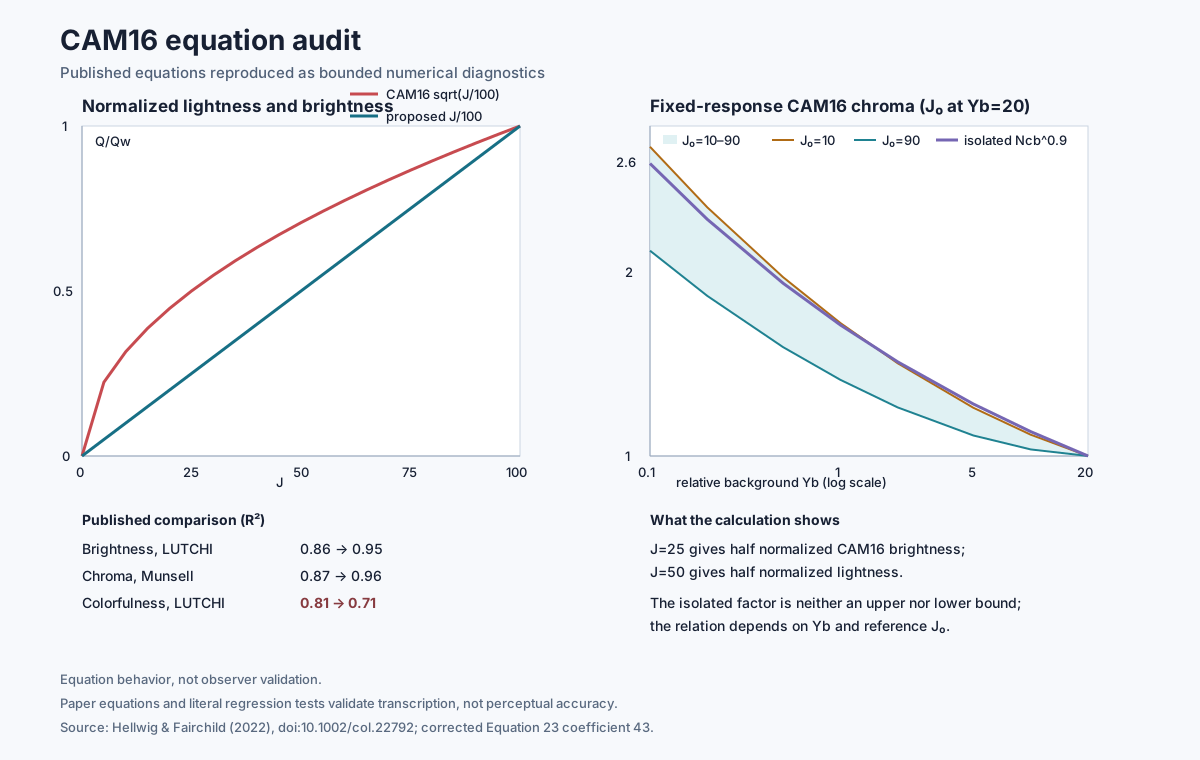
Left: the square-root and linear brightness relations. Center: the isolated
background factor and the coupled range across J = 10…90. Right: the source
paper’s published fits, including the colorfulness regression.
Reference implementation
The relevant calculation from the public C++ implementation.
double cam16_relative_chroma_fixed_adapted_response(
    double y_background, double reference_j,
    double reference_y_background) {
  require_relative_background(y_background);
  require_relative_background(reference_y_background);
  if (!std::isfinite(reference_j) || reference_j <= 0.0 ||
      reference_j > 100.0) {
    throw std::runtime_error(
        "CAM16 equation audit: reference J must be within (0,100]");
  }

  const double n = y_background / 100.0;
  const double reference_n = reference_y_background / 100.0;
  const double z = 1.48 + std::sqrt(n);
  const double reference_z = 1.48 + std::sqrt(reference_n);
  const double isolated =
      std::pow(reference_n / n, 0.18);
  const double chroma_scale = std::pow(
      (1.64 - std::pow(0.29, n)) /
          (1.64 - std::pow(0.29, reference_n)),
      0.73);
  const double lightness_scale = std::pow(
      reference_j / 100.0,
      (z - reference_z) / (2.0 * reference_z));
  const double result = isolated * chroma_scale * lightness_scale;
  if (!std::isfinite(result)) {
    throw std::runtime_error(
        "CAM16 equation audit: coupled chroma expression overflow");
  }
  return result;
}
code/src/cam16_equation_audit.cpp · lines 49–79
Scope of the result
The calculation shows the numerical behavior of the selected equations and why
the isolated background term does not describe the complete coupled expression.
It uses the corrected coefficient 43 in the paper’s colorfulness relation.
This bounded sweep is not a full forward transform, a standards-conformance test, or an observer experiment. The reported coefficients of determination come from the source paper; the observer datasets were not re-fitted here. Determining which formulation better predicts appearance requires suitable observer data.
Source file: studies/color-model-equation-audit.md