Imaging and color measurement · Studies
Is one center-sharpness number enough?
Lens reviews usually answer “how sharp is it?” with a single measurement taken at the middle of the frame, plotted against aperture. The shape of that curve is familiar: soft wide open where residual aberrations dominate, best somewhere in the middle, softening again when stopped down far enough for diffraction to take over.
This study compares two archived capture series from different camera bodies, made with the same 50 mm lens model and chart, asking whether that one center number describes either field.
For the D810, the center curve behaves the way that summary predicts. For the D800, the strongest measured corner at each of four consecutive apertures outresolved the center, by as much as 0.0457 cycles/pixel, and the f/4 center reading fell below the body’s own f/16. Neither departure is visible in the center curve alone. Different focus methods, unrecorded lens-unit identity, and uncontrolled alignment and field orientation keep this at capture-session scope: it is not a camera-body or lens ranking.
What is being measured
Slanted-edge SFR recovers how much contrast a system preserves as detail gets finer. Photograph a straight edge tilted a few degrees from vertical, and each scan line crosses it at a slightly different sub-pixel position; combining the lines reconstructs the edge profile far more finely than the pixel spacing alone would allow.
MTF50 is the usual summary: the spatial frequency, in cycles per pixel, at which contrast has fallen to half its low-frequency value. Higher means finer detail survives. It is one point on a curve, not the curve.
The measurement runs on sensor-linear green samples taken straight from the black-subtracted mosaic — no demosaic, no luma conversion, no gamma — because each of those steps is itself a spatial filter and would be measured as part of the result.
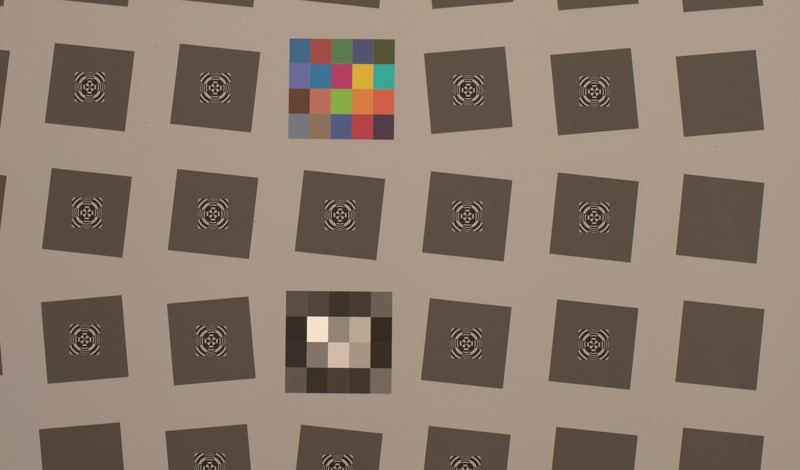
A reduced crop of the target actually captured. The repeated blocks are what makes a field measurement possible: the same edge structure appears at many positions, so center and corner are measured on identical geometry rather than on whatever detail happens to fall there. Illustration only — not a calibration reference or an analysis input.
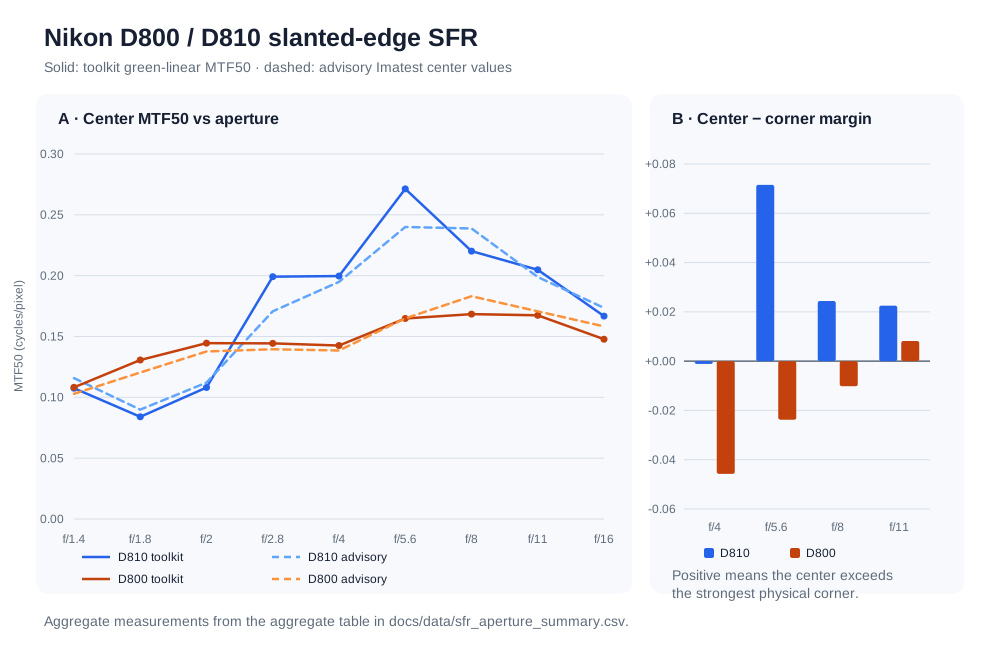
Left: center MTF50 in cycles per pixel against aperture for both systems. Solid lines are this implementation’s sensor-linear green measurement; dashed lines are an advisory reference from a commercial tool that uses a different luma and gamma path, read as a consistency check rather than as agreement. Right: center minus the strongest physical corner. A negative bar means the corner outresolved the center.
The result
The D810 center curve rises to a clean peak of 0.2713 cycles/pixel at f/5.6. At the four mapped field apertures, the center exceeds the strongest physical corner at f/5.6, f/8, and f/11; at f/4 it falls short by 0.0011, a near tie at the reported precision.
The D800 system does not reproduce that shape. Its center peaks lower and later, at 0.1684 at f/8, and two things go wrong that a center-only number cannot show:
- The center is not the sharpest part of the frame across four consecutive apertures. At f/2.8, f/4, f/5.6 and f/8 the strongest measured corner outresolves the center, by as much as 0.0457 cycles/pixel at f/4 — larger than the entire f/4-to-f/8 change in its own center reading.
- Its aperture ordering inverts. The D800 center at f/4 (0.1426) sits below its own f/16 result (0.1477), and the advisory reference reproduces that inversion. Under a well-focused comparable capture, the stronger diffraction penalty at f/16 makes f/4 normally expected to exceed it.
The answer is therefore narrower than a body ranking: the selected D810 center-to-corner comparison behaves conventionally at three mapped apertures, while a center-only summary conceals the D800’s off-axis behavior across four. Nothing in the D800 center curve announces that limitation by itself.
Reference implementation
The relevant calculation from the public C++ implementation.
  std::vector<double> lsf;
  lsf.reserve(esf.size() - 1);
  for (std::size_t i = 0; i + 1 < esf.size(); ++i) {
    lsf.push_back(esf[i + 1] - esf[i]);
  }
  for (std::size_t i = 0; i < lsf.size(); ++i) {
    const double w =
        0.54 - 0.46 * std::cos(2.0 * std::numbers::pi * static_cast<double>(i) /
                               static_cast<double>(lsf.size() - 1));
    lsf[i] *= w;
  }
  const auto mag = dft_magnitude(lsf);
  if (mag.empty() || mag[0] <= kEps) {
    return reject_result(std::move(result), "dc_normalization_zero");
  }

  result.mtf_frequency_cy_per_px.reserve(mag.size());
  result.mtf.reserve(mag.size());
  for (std::size_t k = 0; k < mag.size(); ++k) {
    const double f =
        (static_cast<double>(k) / static_cast<double>(lsf.size())) /
        options.bin_spacing_px;
    double mtf = mag[k] / mag[0];
    const double response =
        adjacent_difference_response(f, options.bin_spacing_px);
    if (response > kEps) mtf /= response;
    result.mtf_frequency_cy_per_px.push_back(f);
    result.mtf.push_back(mtf);
  }
code/src/sfr.cpp · lines 510–538
What this does and does not establish
This is a capture-system result. Slanted-edge SFR includes the lens, aperture, focus and alignment, the optical low-pass filter, sensor sampling, and the processing path, and this archive does not separate them.
Several explanations for the D800 behavior remain live and are not ranked here. The retained records keep at least these alternatives open:
- Optical low-pass filter. The two bodies specify different OLPF designs, which is a plausible body-side contribution.
- Lens sample. Both files record the same lens model, but no serial number survived. The same model is not the same physical lens.
- Focus. The D800 set was manually focused with unverified accuracy; the D810 set used autofocus. A focus error combined with field curvature could produce a similar soft-center and off-axis pattern.
- Setup and alignment. Chart tilt, focus-plane tilt, capture alignment, or decentering could also produce upper/lower or center/field differences, and the retained captures do not isolate them.
Two direct controls would narrow the most obvious alternatives: refocus and repeat each aperture so focus accuracy becomes a measured spread rather than an assumption, and move one lens sample between both bodies so the lens is held fixed by identity rather than by model label. Controlled target alignment and orthogonal edge orientations would still be needed to separate setup and field orientation effects. Until then this supports separate field criteria for these captures, not a ranking of bodies or lenses.
The advisory reference is a consistency check, not a ground truth. It runs a rendered-luma and gamma path where this measurement runs sensor-linear green, so the two are expected to differ in scale; agreement in trend is the useful part. Where they disagree most — the D810 at f/5.6, 0.2713 here against 0.2400 advisory — both still place the peak at the same aperture.
The practical consequence
For these archived measurements, a defensible sharpness criterion must be set per capture system rather than transferred by camera model. A single limit wide enough to pass both would have passed a system whose field maximum sat off-axis through four apertures and whose f/4 center fell below its own f/16 reading.
That is the argument for measuring the field rather than the center — not because corners matter more, but because the center number was the one that looked normal.
Detail: scientific report · method and formulas · published aggregate · reference implementation
Source file: studies/sfr-aperture-and-field.md