Imaging and color measurement · Studies
How far can an incomplete spectral archive be trusted?
Two spectral series can disagree for several reasons: the source may have changed, the instruments may sample wavelength differently, or metadata may send later colorimetry through the wrong observer model. The retained archive contains enough information to locate these disagreements, but not enough to assign their physical cause. That difference—localization without attribution—is the point of this study.
Two retained series differ by 4.327% directional relative L2, and the disagreement is concentrated rather than uniform: two bands, at 530 and 540 nm, carry 75.9% of the squared residual. Excluding them takes the comparison to 2.276%. That locates the problem without naming its cause.
The ideal experiment and the surviving records
The strongest experiment would interleave both instruments on the same monitored source, with geometry, settings, calibration state, wavelength accuracy, and bandpass recorded. Those controls were not retained. What survived were two eight-reading HID-lamp series on different wavelength grids, four exports of one 24-patch reflectance measurement, and a separate candidate pair of chart measurements with incomplete acquisition metadata.
Rather than treating that as either a controlled comparison or useless data, the analysis asks narrower questions the records can answer:
- Is the cross-series difference larger than the variation within each series?
- Which wavelengths carry that difference?
- Which explicit observer reproduces the colorimetry embedded in a self-contradictory export?
- Are four files independent measurements or one measurement serialized four ways?
What the spectra establish
After both HID series are resampled and normalized on the shared 380–730 nm, 10 nm grid, their directional relative-L2 difference is 4.327%. The largest within-series normalized-shape residuals are only 0.307% and 0.207%, so the measured repeat spread does not explain the cross-series difference.
The disagreement is localized. The 530 and 540 nm bands carry 75.9% of the squared residual; excluding those two diagnostic bands reduces the comparison to 2.276%. This identifies where a resolving experiment should look. It does not identify which instrument—or the source—was responsible.
A fitted wavelength offset reduces the fixed-support objective from 4.327416% to 3.084143% at −0.95 nm, a 28.7% reduction. The offset was selected and scored on the same spectra, so it demonstrates sensitivity to relative wavelength registration, not a measured calibration error.
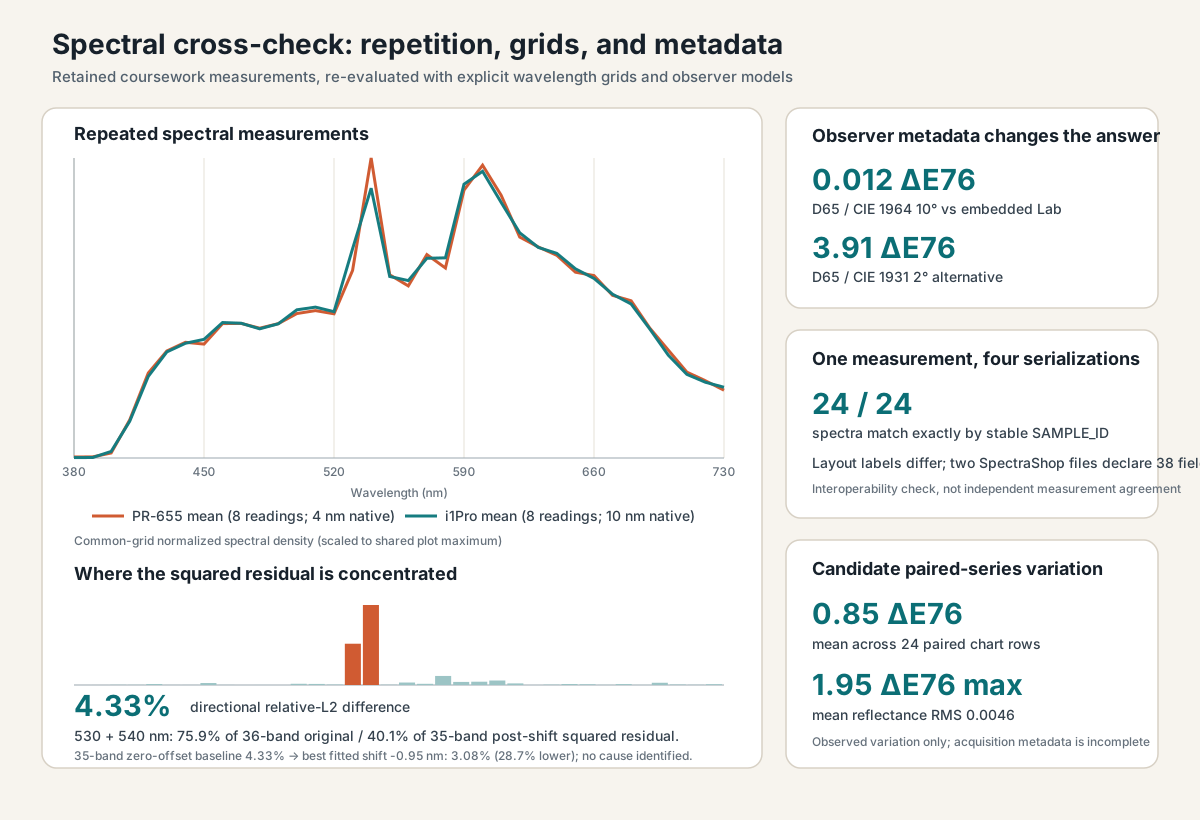
The technical plots carry the numerical comparison. The highlighted 530 and 540 nm bars localize the original disagreement; the three right-hand panels answer separate metadata and interchange questions and are not combined into one accuracy score.
Reference implementation
The relevant calculation from the public C++ implementation.
std::vector<SpectralComparisonBand> comparison_bands(
    const std::vector<double>& axis, const std::vector<double>& reference,
    const std::vector<double>& candidate) {
  double residual_norm = 0.0;
  std::vector<SpectralComparisonBand> result;
  result.reserve(axis.size());
  for (std::size_t index = 0; index < axis.size(); ++index) {
    const double residual = candidate[index] - reference[index];
    if (!std::isfinite(residual)) {
      throw std::runtime_error(
          "spectral compare: signed residual is not representable");
    }
    residual_norm = std::hypot(residual_norm, residual);
    result.push_back({axis[index], residual, 0.0});
  }
  CompensatedSum fraction_sum;
  for (auto& band : result) {
    if (residual_norm == 0.0) {
      band.squared_residual_fraction = 0.0;
      continue;
    }
    const double ratio = std::fabs(band.signed_residual) / residual_norm;
    band.squared_residual_fraction = ratio * ratio;
    fraction_sum.add(band.squared_residual_fraction);
  }
  if (residual_norm > 0.0) {
    const double total = fraction_sum.value();
    if (!std::isfinite(total) || total <= 0.0) {
      throw std::runtime_error(
          "spectral compare: residual contributions are not representable");
    }
    for (auto& band : result) {
      band.squared_residual_fraction /= total;
    }
  }
  return result;
}
code/src/spectral_compare.cpp · lines 183–219
What the metadata establishes
One reflectance export declares both a 2-degree and a 10-degree observer. Recalculation under D65 gives 0.0119 mean ΔE76 against the embedded Lab values with the CIE 1964 10-degree observer, compared with 3.909 under the CIE 1931 2-degree alternative. A second application’s embedded XYZ separately agrees with its declared 2-degree calculation to 0.0469% mean relative L2. Observer choice therefore has to be tested against each declared output rather than inferred from a filename or one conflicting field.
All four exports contain the same 24 spectra by stable sample identity. They demonstrate interchange, not four independent measurements. The candidate chart pair shows 0.851 mean and 1.952 maximum ΔE76 under its declared D55/2-degree calculation, but the missing acquisition conditions limit that to observed paired-series variation—not instrument repeatability or accuracy.
What would resolve the open question
The retained measurements show where the HID disagreement is concentrated and which metadata interpretation is consistent. It cannot separate source change, wavelength registration, spectral bandwidth, geometry, or calibration state. A new interleaved acquisition on a monitored source, with a characterized higher-resolution spectral reference and recorded geometry and settings, would be needed to assign a cause.
Source file: studies/spectral-measurement-crosscheck.md